
The Volunteer Fire Service in New York: A System Sustained by Sacrifice, Not Incentive
New York's volunteer fire service represents one of the most critical yet underappreciated components of the state's emergency response infrastructure. With approximately 60,000 volunteer firefighters serving across the state, these individuals provide essential fire suppression, rescue, and emergency medical services to their communities—often at tremendous personal cost and with minimal financial compensation.
Yet despite their indispensable role, a persistent myth suggests that volunteer firefighters receive standardized incentives, tax credits, or financial support that adequately compensates for their sacrifice. The reality is far more sobering: New York's volunteer fire service is sustained not by incentive, but by sacrifice.
The Economic Reality of Volunteering
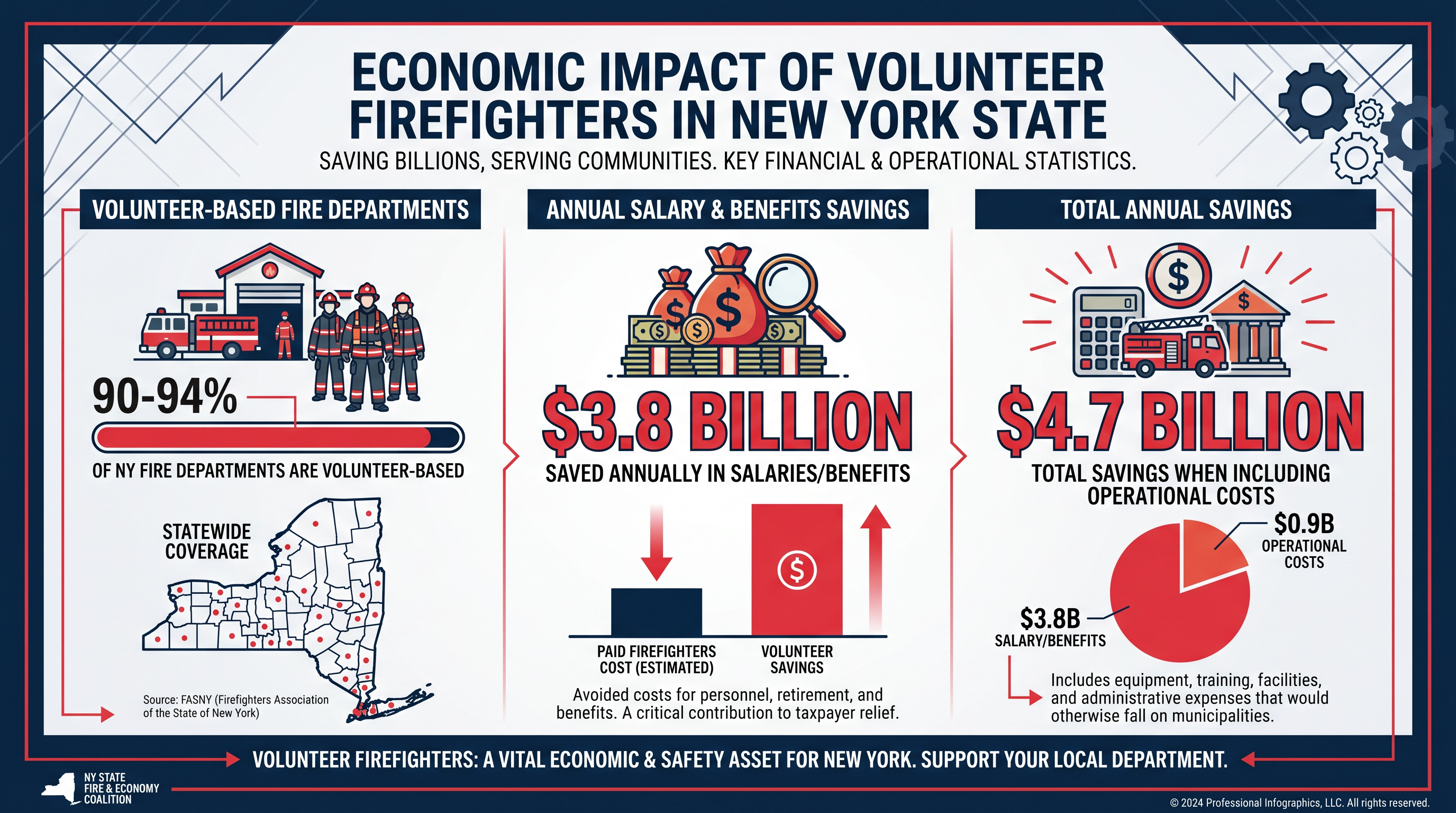
According to the Firefighters Association of the State of New York (FASNY), New York's volunteer fire service generates an estimated $4.7 billion in annual savings to taxpayers through unpaid labor and operational cost savings compared to what it would cost to staff equivalent paid fire departments. This figure accounts for the replacement cost of paid firefighters, equipment, training, and operational expenses that would otherwise burden municipal and state budgets.[1]
However, this enormous economic contribution masks a troubling truth: individual volunteer firefighters often operate at a personal financial loss. Many volunteers spend hundreds or thousands of dollars annually on:
- Personal protective equipment (PPE): Turnout gear, helmets, gloves, and boots can cost $1,500–$3,000 per firefighter
- Training and certification: EMT, paramedic, and specialized certifications require out-of-pocket expenses for courses and exams
- Travel and meal costs: Responding to calls often means leaving work, with no compensation for lost wages or travel expenses
- Continuing education: Maintaining certifications and staying current with protocols requires ongoing investment
The Myth of Standardized Incentives
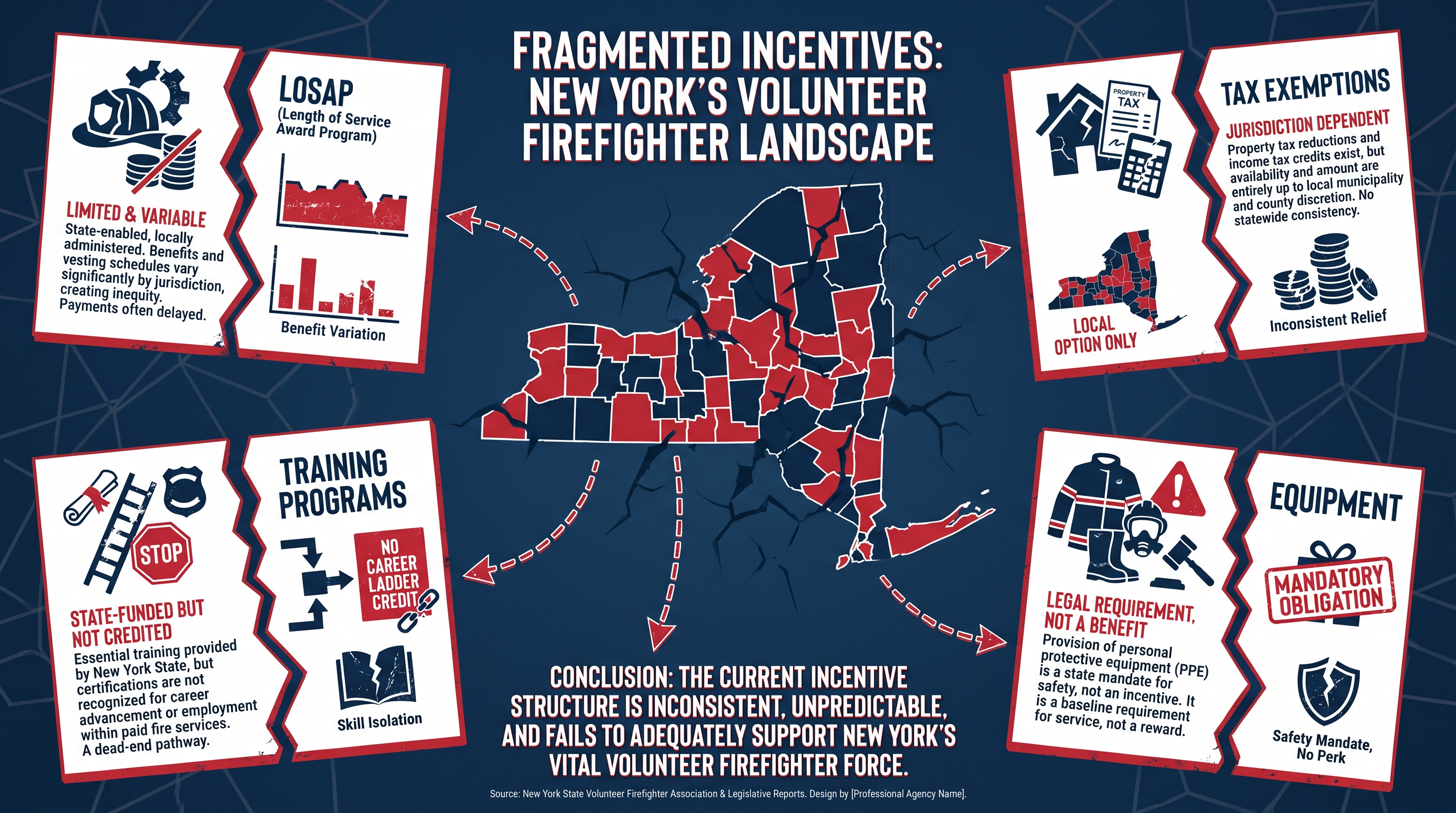
A widespread misconception suggests that New York provides uniform tax credits, property tax exemptions, or financial stipends to all volunteer firefighters. While New York State does offer some incentives—such as a volunteer firefighters and ambulance workers credit—these programs are often underutilized, poorly publicized, and insufficient to offset the true costs of service.
The volunteer firefighters and ambulance workers credit allows eligible volunteers to claim a tax credit of up to $250 per year. While helpful, this modest credit falls far short of covering the actual expenses incurred by active volunteers. Furthermore, many volunteers are unaware of the credit's existence or the eligibility requirements, resulting in significant underutilization.
Property tax exemptions and other local incentives vary dramatically by municipality, creating a patchwork of support that leaves many volunteers without meaningful financial recognition. Some fire districts offer modest stipends ($500–$2,000 annually), while others offer nothing beyond the state tax credit.
The Health and Safety Crisis
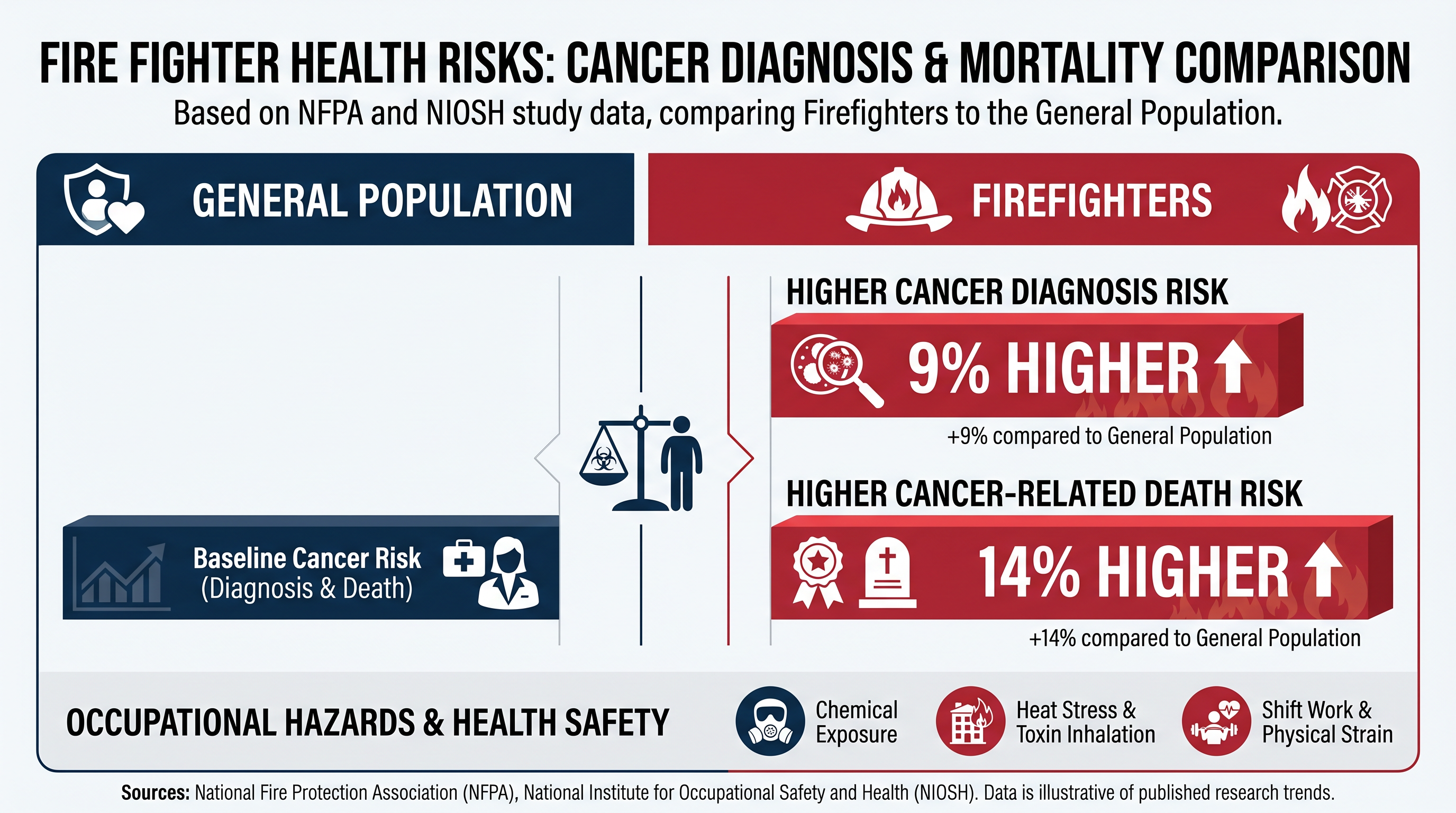
Beyond financial burden, volunteer firefighters face extraordinary occupational health risks. According to the National Fire Protection Association (NFPA), firefighters experience elevated rates of cancer, cardiovascular disease, and mental health disorders—occupational hazards directly linked to their exposure to carcinogens, extreme heat, and traumatic incidents.
The International Association of Fire Fighters (IAFF) reports that cancer is the leading cause of line-of-duty death among firefighters, accounting for approximately 75% of occupational fatalities in recent years — a figure that has risen significantly as the long-term effects of carcinogen exposure among career and volunteer firefighters have become better documented.[4] Yet many volunteer firefighters lack access to:
- Comprehensive health screening: Early detection programs for occupational cancers
- Mental health support: Counseling and peer support for PTSD and trauma-related disorders
- Occupational health insurance: Coverage for work-related injuries and illnesses
- Presumptive illness benefits: Recognition that certain cancers are occupational diseases
New York State has made progress in recent years by expanding presumptive illness benefits for firefighters, but gaps remain. Many volunteer fire departments lack the resources to provide comprehensive health monitoring or mental health support, leaving individual firefighters to navigate occupational health risks without institutional support.
The Cost of Living Crisis
New York's rising cost of living exacerbates the financial burden on volunteer firefighters. Housing affordability, healthcare costs, and general inflation have made it increasingly difficult for volunteers to justify the personal sacrifice required by active service.
According to the U.S. Census Bureau, median home prices in New York have increased dramatically, with many regions experiencing 30–50% increases over the past five years. For volunteer firefighters working full-time jobs to support their families, the combination of occupational expenses, health risks, and rising living costs creates an unsustainable situation.
This economic pressure is contributing to a critical recruitment and retention crisis in New York's volunteer fire service. Younger generations, facing student debt and housing affordability challenges, increasingly view volunteer firefighting as an unaffordable luxury rather than a civic duty.
What True Support Should Look Like
If New York is serious about sustaining its volunteer fire service, policymakers must move beyond symbolic gestures and implement comprehensive support systems that recognize the true cost of service:
- Comprehensive equipment reimbursement: Full coverage of PPE, training, and certification costs
- Occupational health programs: Mandatory health screening, mental health support, and presumptive illness coverage
- Income protection: Compensation for lost wages during emergency responses and training
- Enhanced tax incentives: Increase the volunteer firefighters tax credit to reflect actual costs and ensure universal awareness
- Recruitment and retention bonuses: Financial incentives to attract and retain younger volunteers
- Pension and disability benefits: Ensure that injured or disabled volunteers receive adequate long-term support
The Office of the State Comptroller has highlighted the importance of sustainable fire district financing, noting that many volunteer fire departments operate on razor-thin budgets that leave little room for volunteer support programs. Addressing this requires both state-level policy changes and increased municipal funding for fire services.
The Bottom Line
New York's volunteer firefighters deserve far better than the current patchwork of inadequate incentives and insufficient support. The myth that volunteers receive meaningful financial compensation obscures the reality: these individuals sacrifice their time, health, and financial security to protect their communities.
Until New York implements comprehensive, evidence-based support systems that recognize and compensate for the true cost of volunteer service, the state risks losing the dedicated individuals who form the backbone of its emergency response infrastructure.
Volunteer firefighters are not asking for charity—they are asking for recognition and support commensurate with their sacrifice. New York must answer that call.
References
- Firefighters Association of the State of New York. (2023). Tax savings generated by New York's volunteer fire service. fasny.com
- National Fire Protection Association. (2023). Firefighter injuries in the United States. nfpa.org
- National Institute for Occupational Safety and Health. (2015). Occupational exposure to carcinogens and cancer risk among firefighters. cdc.gov/niosh
- International Association of Fire Fighters. (2021). Firefighter cancer fact sheet. iaff.org
- New York State Department of Taxation and Finance. (2024). Volunteer firefighters and ambulance workers credit. tax.ny.gov
- New York State Office of the State Comptroller. (2022). Fire district financial and budgeting practices. osc.ny.gov
- Fire Department of the City of New York. (2023). Annual budget overview. council.nyc.gov
- New York State Division of Homeland Security and Emergency Services. (2023). Office of Fire Prevention and Control training programs. dhses.ny.gov
- Occupational Safety and Health Administration. (2023). Fire service safety and health standards. osha.gov
- U.S. Bureau of Labor Statistics. (2024). Consumer expenditures and cost of living data. bls.gov
- U.S. Census Bureau. (2024). Housing affordability and demographic data. census.gov
Ready to Get Started?
Explore EMIC emergency medical training for individuals and organizations. Book a class or contact us for group training options.
Related Articles
What to Expect in ACLS Training: A Complete Guide
Preparing for your ACLS certification? Learn what happens during the course, how to succeed, and what skills you'll master in this comprehensive guide to Advanced Cardiovascular Life Support training.
How to Prepare for BLS Certification: Your Complete Checklist
Getting ready for your first BLS certification course? This guide covers everything you need to know, study, and bring to ensure you pass with confidence and gain life-saving skills.