
If you work in emergency services, law enforcement, or public health, you have probably seen a version of the "Myths About Fentanyl" graphic circulating online. Originally published around 2020, the graphic tries to calm the very real panic surrounding passive fentanyl exposure by debunking three common myths.
Its core message is that simply being in the same room as fentanyl or briefly touching it will not cause an instant overdose. Medical toxicologists actually support this basic premise. But the illicit drug supply has evolved at a terrifying pace over the last few years. Today, the information in this graphic is not just outdated. It is dangerously incomplete.
The widespread adulteration of the drug supply with xylazine (an animal tranquilizer) and the emergence of ultra-potent nitazenes (a novel class of synthetic opioids) have completely changed the risk landscape. Here is a breakdown of why the claims in this graphic fall short of keeping first responders safe today.
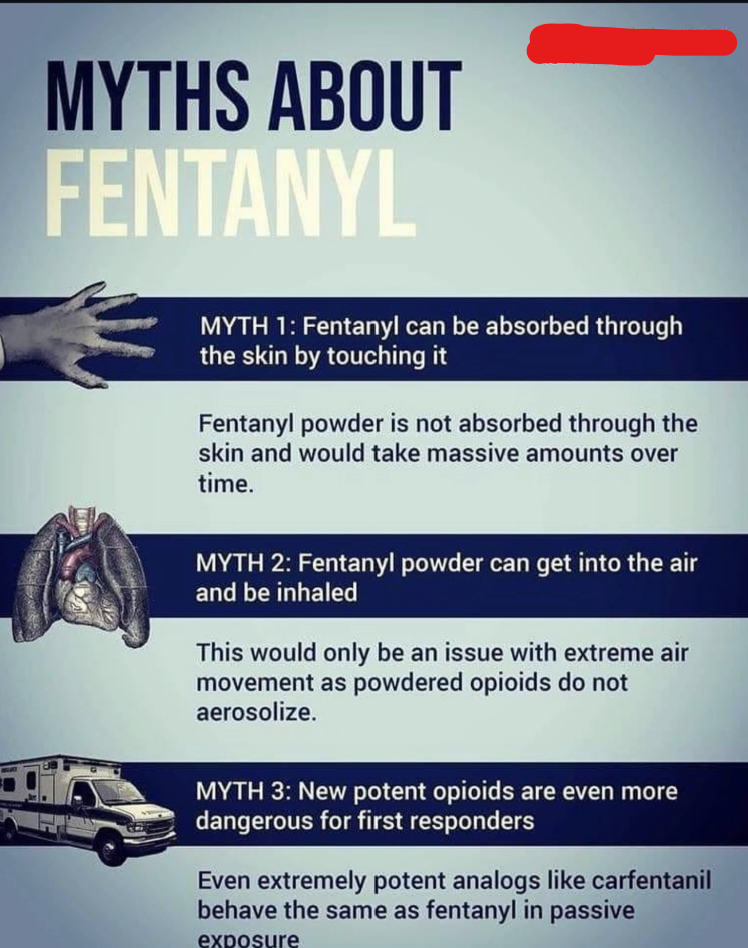
The widely circulated "Myths About Fentanyl" graphic. While its core premise about pure fentanyl is partially accurate, the claims are dangerously incomplete for the 2026 drug landscape.
Claim 1: Dermal Absorption
The Graphic Claims:
"Fentanyl powder is not absorbed through the skin and would take massive amounts over time."
The Reality: Partially Accurate, but Dangerously Oversimplified
The graphic's assertion about pure fentanyl powder is mostly accurate under standard conditions. The American College of Medical Toxicology (ACMT) and the American Academy of Clinical Toxicology (AACT) have consistently maintained that the risk of clinically significant opioid exposure to emergency responders from incidental skin contact is essentially zero [1].
Fentanyl is lipophilic (fat-soluble) and can be absorbed through the skin. That is exactly why pharmaceutical fentanyl patches work. But those patches require specific chemical enhancers and prolonged, continuous contact (often hours) to deliver a therapeutic dose [2]. Brief, incidental contact with dry fentanyl powder on intact skin does not result in rapid systemic absorption sufficient to cause opioid toxicity [1].
The Missing Context: Xylazine and Compromised Skin
While the claim holds true for pure fentanyl, it completely ignores the complexities of the modern drug supply. Enter xylazine (often called "tranq"), a non-opioid alpha-2 adrenergic agonist originally developed as a veterinary sedative [3]. When combined with fentanyl to create "tranq dope," it introduces entirely new risks.
Xylazine exposure is strongly associated with severe, necrotic skin ulcerations that can appear diffusely across the body, even at sites distant from the point of injection [4]. While researchers are still studying the exact mechanism, they theorize that xylazine's potent peripheral vasoconstrictive properties lead to poor tissue perfusion and subsequent necrosis [4].
These wounds are primarily seen in users who inject or smoke the drug. However, the presence of a substance known to cause severe tissue damage means that first responders must exercise extreme caution. If a first responder has compromised skin (like cuts, abrasions, or existing dermatological conditions), the barrier function of the skin is reduced. This can potentially alter the absorption kinetics of any substance they contact. Finally, mucosal transfer (accidentally touching your eyes, nose, or mouth with contaminated hands) remains a very real and rapid route of exposure.
Claim 2: Aerosolization and Inhalation
The Graphic Claims:
"This would only be an issue with extreme air movement as powdered opioids do not aerosolize."
The Reality: Largely Accurate for Spontaneous Conditions, but Incomplete
The graphic is correct in stating that fentanyl powder does not spontaneously aerosolize under normal ambient conditions. Fentanyl has an extremely low vapor pressure (4.6 × 10⁻⁶ Pa), meaning it is not volatile and does not evaporate into a gaseous phase at room temperature [1]. Simply being in the same room as undisturbed fentanyl powder does not pose an inhalation risk.
The Missing Context: Mechanical Disturbance and Vaping
The graphic's dismissal of inhalation risks is overly broad. While spontaneous aerosolization does not occur, mechanical disturbance of the powder (such as opening tightly sealed packages, sweeping, or sudden gusts of wind) can suspend fine particulates in the air [5]. If these particulates are inhaled, fentanyl has a high bioavailability (ranging from 12% to 100%) through the pulmonary route, meaning it can be rapidly absorbed into the bloodstream [1].
Furthermore, the methods of consuming illicit opioids have evolved. The practice of smoking or vaping fentanyl and its analogs has become increasingly common. Studies conducted at supervised consumption sites have detected measurable airborne concentrations of fentanyl in rooms where the drug was actively being smoked [1]. These levels were generally deemed too low to cause acute physical health effects in bystanders during short-term exposure. Still, first responders entering enclosed, poorly ventilated spaces where drugs have recently been smoked or where large quantities of powder are being actively processed face a genuine, albeit situational, inhalation risk.
Claim 3: Potency of Analogs and Passive Exposure
The Graphic Claims:
"Even extremely potent analogs like carfentanil behave the same as fentanyl in passive exposure."
The Reality: The Most Dangerous and Outdated Claim
This is where the graphic fails most critically. It is true that the basic physics of passive dermal absorption remain similar across different pure opioid analogs (meaning dry powder on intact skin absorbs very slowly). But the graphic ignores the critical variables of extreme potency and the introduction of entirely new chemical classes.
Carfentanil is estimated to be 10,000 times more potent than morphine and 100 times more potent than fentanyl [1]. While passive dermal exposure might still be slow, the absolute amount of the substance required to cause a lethal overdose is microscopic. Therefore, any accidental ingestion, mucosal exposure, or inhalation of disturbed powder carries an exponentially higher risk with ultra-potent analogs.
The Missing Context: Nitazenes and Naloxone Resistance
The graphic was likely created before the widespread proliferation of nitazenes, so it completely fails to address this new class of synthetic opioids. Nitazenes (benzimidazole-opioids), such as isotonitazene and metonitazene, emerged significantly in the illicit market around 2019 [6]. They are structurally distinct from fentanyl and exhibit extreme potency. Isotonitazene, for example, is estimated to be 500 times more potent than morphine [6].
The risks associated with nitazenes are profound:
- Prolonged Toxicity: Nitazenes often cause severe and prolonged respiratory depression that can outlast the effects of standard doses of naloxone (Narcan) [6].
- Naloxone Resistance: While naloxone is effective against nitazenes, reversing an overdose often requires multiple, higher doses and extended clinical monitoring [6].
- Detection Challenges: Standard field test kits and routine toxicology screens frequently fail to detect nitazenes, leaving first responders and medical personnel unaware of the specific substance they are handling [6].
Furthermore, the graphic's claim that all analogs "behave the same" is dangerously false when applied to xylazine. Because xylazine is an alpha-2 adrenergic agonist and not an opioid, it does not bind to opioid receptors and is completely unaffected by naloxone [3]. When a patient overdoses on a fentanyl-xylazine mixture, administering naloxone may reverse the opioid-induced respiratory depression, but the patient will remain deeply sedated and unresponsive due to the xylazine [3]. This complex clinical presentation requires supportive care (airway management, ventilation) rather than simply administering more naloxone. The graphic misses this nuance entirely.
The Nocebo Effect: Why the Myth Persists
We have to address why reports of first responders "overdosing" from passive exposure continue to circulate despite toxicological evidence to the contrary. Medical toxicologists and researchers attribute many of these incidents to the "nocebo effect" or context-driven anxiety (panic attacks) [7].
When first responders, primed by misinformation and high-stress environments, believe they have been exposed to a deadly substance, they can experience severe, real somatic symptoms such as tachycardia (rapid heart rate), hyperventilation, dizziness, and syncope (fainting) [7]. These are symptoms of acute anxiety, not opioid toxicity. The hallmark signs of an opioid overdose are respiratory depression (slowed or stopped breathing), miosis (pinpoint pupils), and loss of consciousness [1]. Misinterpreting panic attacks as overdoses perpetuates the myth of passive exposure lethality and can lead to inappropriate medical treatment.
The Bottom Line
The "Myths About Fentanyl" graphic presents a simplified view of opioid exposure that was partially accurate for pure fentanyl powder but is dangerously obsolete in the context of the 2026 illicit drug landscape.
While panic regarding passive dermal exposure to pure fentanyl is unwarranted, extreme caution, appropriate personal protective equipment (PPE), and an understanding of novel synthetic opioids and adulterants are absolutely essential for operational safety today. This includes wearing nitrile gloves and, in situations with disturbed powder, N95 respirators and eye protection.
Do not let an outdated graphic lull you into a false sense of security. The drug supply has changed, and our safety protocols must change with it.
References
- ACMT and AACT Position Statement: Preventing Occupational Opioid Exposure to Emergency Responders (Updated November 2025). American College of Medical Toxicology. acmt.net
- Moss, M. J., et al. (2018). ACMT and AACT Position Statement: Preventing Occupational Fentanyl and Fentanyl Analog Exposure to Emergency Responders. Clinical Toxicology. pmc.ncbi.nlm.nih.gov
- Xylazine and Fentanyl: Why This New Street Drug Combination is Keeping First Responders Up at Night. (2023). ECS Institute. ecsinstitute.org
- FDA warns about the risk of xylazine exposure in humans. (2022). U.S. Food and Drug Administration. fda.gov
- NRT Quick Reference Guide: Fentanyl. (2025). National Response Team. nrt.org
- Pereira, J. R. P., et al. (2025). Nitazenes: The Emergence of a Potent Synthetic Opioid Threat. Molecules, 30(19), 3890. mdpi.com
- del Pozo, B., et al. (2021). Police reports of accidental fentanyl overdose in the field: Correcting a culture-bound syndrome that harms us all. International Journal of Drug Policy. pmc.ncbi.nlm.nih.gov